
E-Commerce Fulfilment Centres: Scaling Knife Safety from 10 to 1,000 Workers

A fulfilment centre might run comfortably with only ten permanent staff in the month of March. By late November, the same site may need, and the largest sites close to a thousand. Australia Post delivered almost 111 million parcels in November and December 2025, its busiest peak on record, and the warehouses behind that network hire to match. Many of those new starters will pick up a cutting tool on their very first shift.
Coaching each person one-on-one works for a team of ten, but it falls apart when fifty casuals turn up in a week. E-commerce warehouse safety at scale therefore needs a different approach: one approved knife and one set of rules for everyone on the floor, whether they started in March or last Monday.
Why Knife Safety Becomes More Challenging as E-Commerce Warehouses Scale
Permanent staff know the site and its quirks. Casual and labour hire arrivals know neither, yet they work beside veterans at full peak volume, across more stations than a single supervisor can watch.
The national numbers explain why that matters. Safe Work Australia recorded 21,500 serious claims for wounds, lacerations, amputations and internal organ damage in 2024–25 (preliminary data), or 14.6% of all serious claims. Transport, postal and warehousing contributed 10,600 serious claims of every type, which is 7.2% of the national total. Experience plays a part, too. SafeWork NSW notes that labour hire workers are less likely to receive workplace-specific training and induction, and the Australian Bureau of Statistics found that one in five people injured at work in 2021–22 were employees without paid leave entitlements, the ABS measure of casual work.
Five Major Knife Safety Challenges During Peak E-Commerce Seasons
Most fast-growing sites run into the same five problems.
1. Onboarding 50+ Casual Workers in a Single Week
The main problem is time. Long training sessions take staff away from their work right when the business is busiest, so training is usually the first thing cut. A five-minute session survives this pressure because it can easily be repeated for every new group of workers, while a forty-minute presentation cannot.
2. Maintaining Safety Standards Across Labour Hire and Casual Staff
When a workplace relies on casual and labour hire workers, safety rules often stay in the minds of the few people who wrote them. Safe Work Australia's labour hire guidance recommends that host businesses give every labour hire worker a site-specific safety induction, and the host and labour hire provider must consult, cooperate and coordinate with each other on safety. One approved best cutter knife and one clear rule make that induction much quicker to deliver than a long training manual.
3. Managing Cutting Tools Across Multiple Warehouse Stations
Staff move around stations and share benches. They also carry the tools with them. There should be an assigned home and a regular count; otherwise, nobody can say how many knives are on the floor or where each one belongs.
4. Preventing Bring-Your-Own-Knife Behaviour
Experienced casuals often arrive with a safety knife they've used for years. A personal knife may not have the blade retraction the site relies on, and nobody has inspected it. We cover how to handle this further on.
5. Maintaining WHS/OHS Compliance During Peak-Period Pressure
Overtime and dispatch cut-offs invite shortcuts, and any safety step that slows a packer down will eventually lose to one. Each step must be quick enough to survive a busy shift.
Where Safety Knives Fit in the Hierarchy of Control
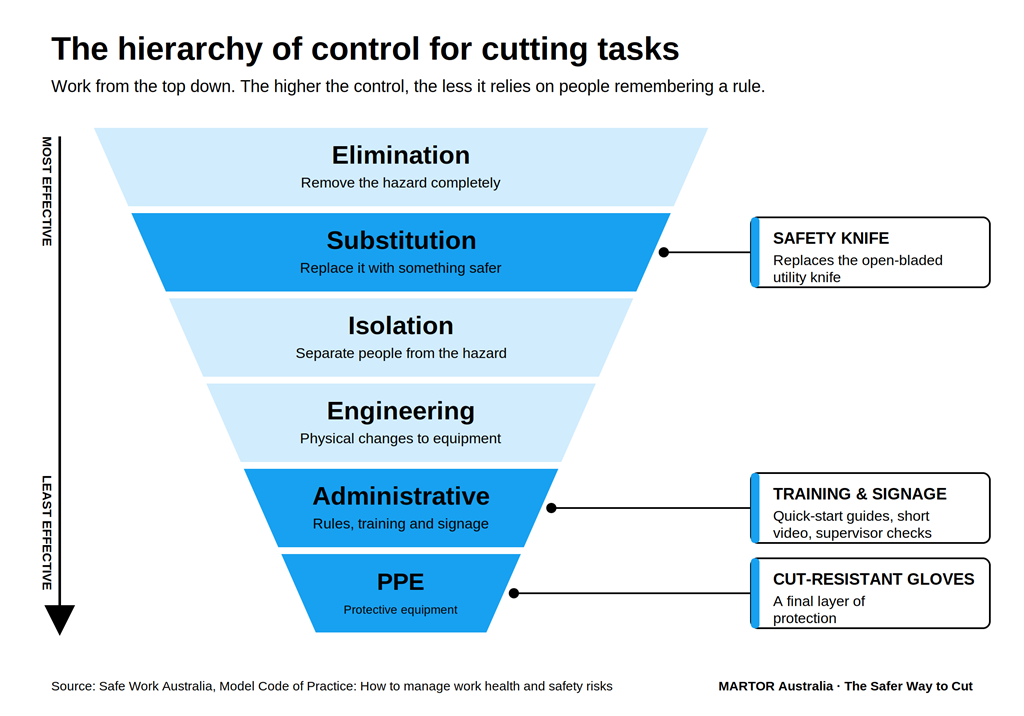
Australian WHS and OHS laws expect businesses to work down the hierarchy of control: remove the hazard where possible, then substitute or engineer it out, and only then rely on rules, training and protective equipment. Swapping open-bladed utility knives for safety knives is a substitution control, because it changes the tool rather than relying on workers to remember a rule. Training, signage and supervision are administrative controls and cut-resistant gloves are PPE. Safe Work Australia rates these last two as the least effective because they depend on people’s behaviour, and peak season, with a floor full of new starters, is when you can least rely on that. The strongest approach uses all three: the knife does the heavy lifting, training and signage back it up, and gloves add a final layer.
How to Build a Scalable Knife Safety Program for Fulfilment Centres with MARTOR
As headcount grows, training time stretches thin, so most of the protection has to be built into the tool and the workstation.
Standardise Safety Knives Across the Workforce
The first step is to retire open-bladed utility knives and apply a no-exposed-blades rule at every site. MARTOR's SECUPRO knives suit this well because of their fully automatic blade retraction: the blade retracts as soon as it leaves the material, even if the user keeps pressing the slider or lever. That removes a step people often forget, even after training. Where workers should have no contact with the edge at all, or where goods are easily damaged, the SECUMAX range has a concealed blade.
Check that your standard knife suits left-handed workers too. Many MARTOR models, including the SECUPRO MAXISAFE, are designed for both.
We recommend one standard all-purpose knife alongside a few clearly defined specialist tools. If you haven't audited your current tools yet, our knife safety program guide is the place to start.
Simplify Onboarding with Quick-Start Visual Guides
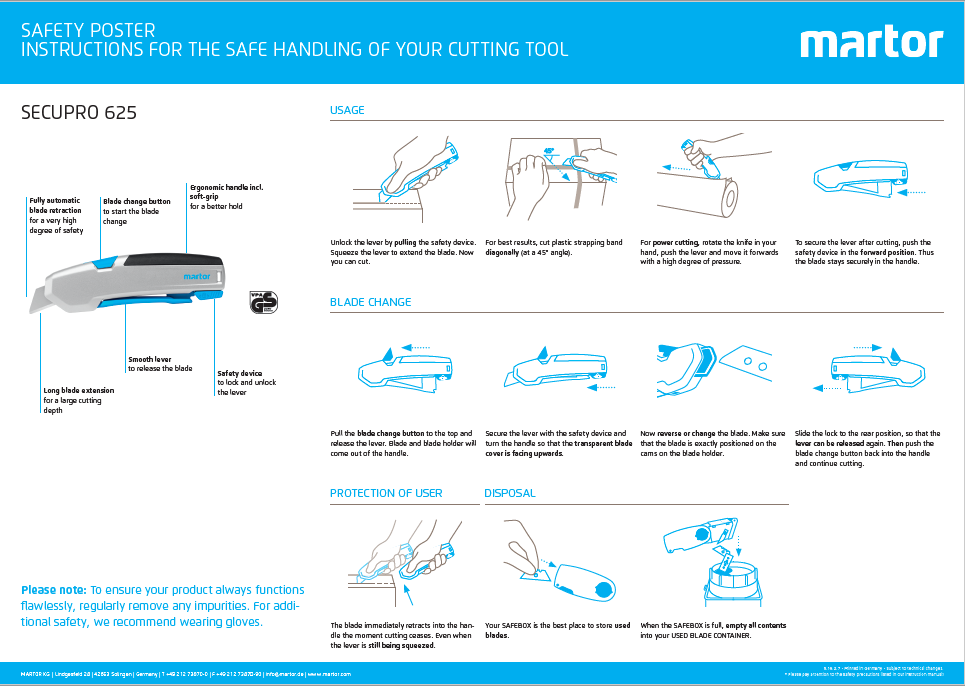
Visual guides show how to grip and the direction of cut. MARTOR advises holding the knife at about 45 degrees while cutting cartons and strapping. Another panel can state "Blade retracts. No exceptions." Place these panels at eye level at every pack station and on the returns bench. Workers see the message every time they walk past.
Introduce Five-Minute Mobile-Friendly Safety Training
Short videos make knife safety training easier to deliver for casual and labour hire workers who join during busy periods. A mobile-friendly video accessed through a QR code can cover:
-
How to use the approved knife.
-
How blade retraction works.
-
How to carry and store the tool.
-
What to do with a damaged or missing knife.
The video demonstrates the basics; the competency check happens on the floor. After watching it, each worker should show a supervisor that they can use and store the knife safely. The worker and supervisor then both sign a one-line sign-off form, which is kept as a training record. Keep a company tablet on hand for anyone without a smartphone.
Use Colour-Coded Knives for Different Warehouse Zones
Each area should have an assigned colour for knives. For example, receiving – yellow, picking – blue, packing – green and returns – orange. Use handle colour where the knife comes in a choice of colours; otherwise use coloured holsters, tags or labelled storage.
This helps workers pick up the right tool and helps supervisors spot knives that have moved between zones. It can also support inventory checks, as supervisors can count knives by colour during shift handovers or workstation inspections.
In facilities handling food or sensitive goods, colour coding should be part of a wider hygiene and tool-control system.
Establish a Centralised Knife Inventory and Replacement Process
There must be a record of issued and missing knives. The register should also have replacement dates and the storage location for each tool.
Every knife should have a designated storage area, such as a labelled rack or workstation holder. Workers should report lost or damaged knives immediately and place damaged tools in a designated area for removal or repair.
Supervisors can run knife checks at shift handover and during routine workstation inspections to confirm that tools are stored correctly. Regular replacements prevent workers from relying on blunt or unsuitable tools.
Blade changes are a cutting risk, especially for new starters. Choose knives with a tool-free blade change and keep a used-blade container in each zone so old blades never end up loose in a general bin. MARTOR’s used blade containers lock shut once full, so they can go straight to disposal.
How to Maintain Knife Safety During Black Friday and Christmas Peak Periods
In Australia, peak now runs from the November sales events (Click Frenzy, Black Friday and Cyber Monday) through Christmas and Boxing Day, followed by the returns that come back in January. Audit your cutting procedures before volumes rise, and stock enough approved safety knives and replacement blades before recruitment begins. Add knife safety to the onboarding checklist for every new worker, including labour hire workers. Supervisors should watch cutting practice in each zone. Regular inventory checks pull damaged tools out of circulation. Reviewing incidents and near misses as they come in will show where to act next.
Addressing "bring your own knife"
Experienced casuals tend to arrive with their own knife, and habit explains most of it: they've used the same tool for years and trust the feel of it. Some also doubt the site's own tools, having been handed blunt or awkward ones before. The trouble is that a personal knife may lack the retraction the site relies on, and nobody inspects it or even knows it's there.
The fix is to issue a good safety knife at induction and let workers try it before their first shift, because most objections fade once the knife cuts well. After that, set one rule in writing: only site-issued knives on the floor. Put it in the induction and on the quick start guide, and have supervisors check at each pre-start. When a supervisor spots a personal knife, they swap it for an issued one on the spot and point the worker to a locker. Apply the rule to permanent staff too, so it never reads as a judgement on the newcomers.

A Peak-Season Rollout Checklist
To pull all this together, here's a timeline that works back from the first week of peak. If peak is already closer than eight weeks away, start at the row that matches your timing and run the earlier steps together.
| Timing | Action |
| 8 weeks before peak | Audit current cutting tools; order knives and replacement blades |
| 6 weeks before | Brief labour hire providers on the knife rules; add the rules to the labour hire induction |
| 4 weeks before | Install station signage; finalise the training video and sign-off form |
| 2 weeks before | Brief supervisors; set up the inventory register and tool storage |
| Week one of peak | Issue knives at induction; cover it again at each pre-start or toolbox talk |
| Weekly through peak | Count knives; review near misses and damaged tools |
Conclusion: Make Safety Visible Before the Rush
Two changes carry most of the load—a knife that retracts itself and training short enough to repeat for every intake. Supervisors, signage and regular counts keep both in place once the rush starts. At MARTOR, safe cutting is all we've done, so our team can audit your current tools and match knives to your cutting tasks.
Request a free sample knife or contact MARTOR Australia to plan your peak-season safety knife rollout.