
Food Safety Meets Worker Safety: Selecting Food-Grade Cutting Tools for Australian Food Manufacturers
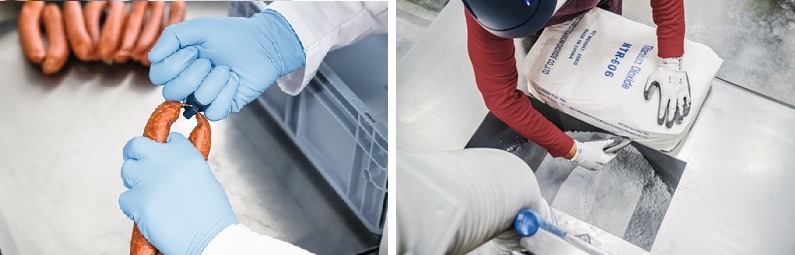
In 2025, Food Standards Australia New Zealand coordinated 92 food recalls nationally. Twenty-two of them came down to one cause: foreign matter in the product. For a food safety manager, that single statistic says everything about why a cutting tool can't just be assessed on how well it protects a worker's hand.
A safety knife bought for the warehouse floor might be the wrong tool for the production line beside it. Warehousing knives are built to guard against lacerations, and that's the job they do well. But drop that same knife into a bakery, a meat room, or a packaging line, and new questions appear. What's the handle made from? Will a metal detector detect a cracked component before it reaches a customer? Can the blade be swapped without a stray fragment ending up in the mix?
This is where worker safety (WHS) and food safety compliance start pulling in different directions, and where food manufacturers need a cutting tool strategy that satisfies both.
Understanding the Australian Regulatory Landscape
Australian food manufacturers work primarily within the Food Standards Australia New Zealand framework and the requirements of their relevant state or territory food authority. FSANZ's Standard 3.2.2 covers the cleaning, sanitising and maintenance of food premises and equipment, and is explicit that chipped, cracked or broken utensils must not be used where they could contaminate food.
For plastics specifically, Australia leans on AS 2070:1999, the Australian Standard for plastics materials for food contact use. Although this standard was formally withdrawn in 2021, FSANZ still references it in an editorial note as industry guidance. AS 2070:1999 references US FDA regulations (21 CFR) and EU food-contact rules rather than setting its own Australian testing regime. FDA compliance itself only becomes directly relevant when exporting to the US — domestically, FSANZ standards (particularly Standards 1.4.1 and 1.4.3) are the reference points that apply to food businesses in Australia.
Layered on top are third-party certification schemes — BRC, SQF and FSSC 22000 — which most manufacturers supplying major retailers or export markets must hold. These go further than the legislation, and cutting tools sit squarely inside their scope.
HACCP and Cutting Tools: What to Consider
HACCP (Hazard Analysis and Critical Control Points) is the food safety management framework used by manufacturers to identify and control risks in production. A cutting tool doesn't automatically qualify as HACCP-compliant just because it's marketed as a "safety knife." That assessment belongs to the manufacturer's own hazard analysis.
Physical contamination from cutting tools tends to fall into a few recognisable patterns: a cracked handle shedding plastic, a loose screw working free during use, or a blade fragment breaking off mid-cut. None of these is a dramatic event. They're small, cumulative wear issues, which is precisely why they're easy to miss without a deliberate control point.
Working definition: Under HACCP, a Critical Control Point (CCP) is a step where a control can be applied to prevent, eliminate or reduce a food safety hazard to an acceptable level. Cutting tools become part of this picture wherever manual cutting happens close to exposed product.
The practical takeaway is straightforward: cutting tools belong in the hazard analysis, not just the PPE register.
What Does "Food-Grade" Actually Mean?
 "Food-grade" gets used loosely in marketing, and food safety managers are right to be sceptical of it as a label alone. What it should mean, in practice, is that a tool's materials — handle and blade alike — are suitable for the environment they'll be used in, resistant to the kind of contamination that matters (splintering, absorbing moisture, harbouring bacteria in surface pitting), and designed to be cleaned properly between uses.
A smooth, sealed handle that can be wiped down and inspected quickly is doing more real food safety work than a tool that simply carries a food-grade sticker. The right question for a QA manager isn't "is this labelled food-grade?" It's "does this material and design suit our specific food-contact application?"
Why Metal-Detectable Knives Matter in Food Manufacturing
Metal-detectable plastic (MDP) knives are built so that the tool itself, and any fragment that breaks off it, can be picked up by a metal detector or X-ray system before product leaves the site. That matters because a cracked handle or snapped component is otherwise invisible to standard inline detection.
It's worth being precise here: metal-detectable knives aren't a blanket requirement under FSANZ or HACCP as a matter of law. Whether they're needed comes down to a site's own risk assessment, its HACCP plan, and often a specific customer or auditor requirement. FSSC 22000 Version 6 makes this explicit — clause 2.5.11 requires certified sites to carry out a documented risk assessment to determine whether foreign body detection equipment, and by extension detectable tools, is warranted for their operation.
For high-risk zones — open product areas in bakeries, meat rooms, and ready-to-eat lines — that assessment very often lands on "yes."
Preventing Cross-Contamination from Cutting Tools
Selecting the right tool solves only part of the problem. Keeping it clean, stored correctly, and confined to the area it's meant for is where day-to-day discipline comes in.
- Dedicate tools to zones — a knife from raw material receiving shouldn't move into a ready-to-eat area without cleaning and inspection first.
- Store on fixed points, not loose on benches, to cut the chance of a tool ending up somewhere it shouldn't.
- Build cleaning into the schedule, using methods validated for the tool's material.
- Inspect routinely for cracks, chips or wear that open up a contamination pathway.
Each ties back into the site's broader food safety management system rather than sitting apart from it.
Safe Blade Changes and Knife Maintenance
Ironically, the moment a blade change happens — when a fresh blade is being installed and components are exposed and handled — is when contamination risk is highest. That's precisely when small parts can break free, screws can work loose, or blade fragments can go missing into product.
A controlled blade-change procedure confirms the old blade is fully removed and accounted for, the new one is seated with no loose fragments left behind, and the knife passes a quick visual check before returning to service. Used blades need a secure, dedicated disposal point — not a pocket or a nearby bin. Skip any of these steps and routine maintenance becomes an unplanned contamination event.
Third-Party Audit Expectations: BRC, SQF and FSSC 22000
Auditors under these schemes don't typically prescribe one exact make or model of safety knife. What they expect is evidence of control: documented tool inventories, inspection records, and a clear rationale for material and detectability choices.
Worth knowing: BRCGS Global Standard for Food Safety (Issue 9), clause 4.9.2.1, requires a documented policy for controlling sharp metal implements — knives, cutting blades, needles and wires — and rules out snap-off blade knives specifically. It's a precise, checkable requirement that trips up manufacturers who haven't reviewed their cutting tools against the standard's current wording.
FSSC 22000's foreign-matter clauses and SQF's equipment modules follow a similar logic: show your reasoning, show your maintenance records, and show that cutting tools were part of the hazard analysis from the start.
Real-World Application
MARTOR's metal-detectable range has an established track record in food manufacturing internationally — including with large processors such as Iglo, whose quality management team has spoken publicly about integrating MDP knives and detector test cards into daily production.
Practical Checklist: Are Your Cutting Tools Suitable for Food Manufacturing?
| Check | Why it matters |
| Materials suit the food-contact application | Prevents splintering, absorption and bacterial harbourage |
| Tools included in the site's HACCP hazard analysis | Closes a common compliance gap |
| Metal-detectable tools used where risk assessment supports it | Aligns with FSSC 22000 clause 2.5.11 |
| Tools inspected on a set schedule | Catches wear before it becomes contamination |
| Cleaning and hygiene procedures documented | Supports audit evidence |
| Tools dedicated to zones, not shared freely | Reduces cross-contamination pathways |
| Blade changes follow a controlled procedure | Prevents loose fragments entering product |
| Used blades are disposed of via a secure system | Removes a common oversight |
| Tools support both WHS and food safety audits (BRC, SQF, FSSC 22000) | Avoids duplicated or conflicting controls |
Conclusion: Choose Cutting Tools That Address Both Risks
Evaluating a cutting tool purely on cut-injury prevention leaves half the risk picture unexamined. The stronger approach weighs WHS protection alongside food safety: material suitability, HACCP alignment, detectability, hygienic design, and audit-readiness together.
MARTOR's food-grade, metal-detectable safety knives are built with exactly that dual brief in mind. Explore the metal-detectable range, or contact the MARTOR Australia team to talk through what a site-specific risk assessment might look like for your operation. Prefer to test one first? Request a free sample knife and see how it performs on your line.