
The Real Hidden Costs of Unsafe Cutting Tools in Australian Retail Stores
Introduction

Retailers must understand the real impact unsafe cutting tools have on workplace safety and the bottom line. These tools have immediate consequences on staff availability and product loss.
In Australia, retail workplace injuries remain a serious concern. According to Safe Work Australia, 146,700 serious workers’ compensation claims were lodged nationally in 2023–24 — and many stores continue to expose employees to unnecessary risk by relying on low-cost box cutters instead of purpose-built retail safety knives like those from the MARTOR SECUMAX range.
Store employees use cutting tools daily to open cartons and unpack deliveries, often under significant time pressure. Unsafe cutting tools not only injure staff — they also damage stock during unpacking. Cuts and lacerations are common day-to-day accidents that interrupt operations and cause financial damage that compounds over time.
Evidently, retailers have been bearing these losses quietly through reduced margins and write-offs.
Learn What to Look for in a Retail Safety Knife ›
The Real Financial Impact of Unsafe Cutting Tools in Retail
Using unsafe tools leads to multiple expense categories — including injury costs and operational disruption — but direct medical costs are often only a fraction of the total financial burden.
Workers’ Compensation and Medical Expenses
Retailers are responsible for first aid and initial medical treatment. When injuries involve deeper cuts requiring stitches and follow-up care, recovery time increases — and so does time away from work.
Beyond the immediate financial implications, workers’ compensation claims require documentation and internal investigation under Work Health and Safety (WHS) obligations. Retail chains absorb these expenses at scale when they compound across multiple departments and sites.
Lost Productivity from Injured Staff
When an injured employee is absent, store operations are affected. Everyday tasks like stock processing and unpacking either stop or shift to other staff who are already managing their own workloads. This takes a toll on sales readiness and places extra pressure on the remaining team.
Replacement Hiring and Training Costs
When injuries result in extended leave, stores must either hire temporary staff or redistribute workload across the existing team. Both options carry a real cost:
-
Temporary staff require onboarding before they are productive
-
New employees need close supervision during the learning period
-
Training draws on senior staff time and attention
-
Productivity falls while replacements get up to speed
Customer Service Disruption During Trading Hours
During busy trading hours, operating with fewer staff makes it difficult to manage the store floor effectively. This leads to slower checkout support and reduced floor assistance — both of which affect sales conversion and the likelihood of repeat visits.
Stores with a repeated accident history also face higher ongoing insurance premiums, turning workplace safety failures into a fixed operational expense.
Hidden Product Damage Caused by Unsafe Box Cutters

Frequently, unsafe cutting tools cause product damage that directly reduces retail profitability — yet this cost is rarely tracked as a separate line item.
Merchandise Damage from Exposed Blades
Traditional box cutters use open blades that cut too deeply and without control. During unpacking, these blades regularly pierce into products, causing damage before items ever reach the shelf. By contrast, every knife in the MARTOR SECUMAX range uses a fully concealed blade engineered to cut through packaging without reaching the merchandise inside. Common damage caused by unguarded box cutters includes:
-
Clothing cuts in folded apparel
-
Scratched or cracked packaging on electronics
-
Damaged plastic seals on consumer goods
-
Scored surfaces on boxed products
Even minor damage is typically enough to render an item unsellable, requiring removal from saleable inventory.
Inventory Losses During Unpacking
Retail stores routinely process large volumes of stock under tight time constraints. When staff are moving quickly through hundreds of cartons, small handling errors are inevitable. These individual incidents scale into measurable inventory shrinkage across a week, a month, and a financial year.
Impact on Profit Margins
Product damage reduces margin twice: first, the retailer loses the cost of the damaged item; second, they lose the expected revenue from the sale.
Additional hidden costs include:
-
Supplier credit negotiations and administration
-
Disposal or return handling
-
Re-order delays that create gaps in stock availability
-
Reduced stock availability during peak demand periods
Retailers rarely track these losses as a separate cost category, which means the true financial impact often goes unrecognised until it shows up as unexplained margin erosion.
Retail Workplace Injuries Australia – Cost Breakdown Analysis
When all factors are considered, a single retail cutting injury can cost a store significantly more than most managers expect. Safe Work Australia data shows the average workers’ compensation payout for a serious claim in 2020–21 was approximately $15,100 — and that figure covers compensation only. When indirect costs are included, the total impact of a single injury can reach well above that figure, driven by:
-
Medical treatment and rehabilitation
-
Workers’ compensation payments
-
Staff replacement and training
-
Lost productivity during recovery
-
Administrative and compliance workload
For retailers operating a chain of stores, repeated incidents represent a steady and significant financial drain. Costs escalate further when injuries occur during peak trading periods or affect multiple staff members at the same location.
There is a human cost too. Repeated injuries erode staff confidence and morale, which can reduce performance and increase turnover — particularly among employees who feel unsafe using the tools provided. WHS compliance also demands that retailers demonstrate active risk control measures, including safe tool selection and appropriate training.
Is Your Store at Risk? Find Out Now ›
Why MARTOR Retail Safety Knives Deliver Faster ROI
MARTOR retail safety knives reduce risk by design. Every knife in the SECUMAX range features a fully concealed blade — meaning workers cannot make accidental contact with the cutting edge during or between cuts. Fixed cutting depths matched to each task prevent blades from piercing too deeply into packaging, protecting the merchandise inside. Each model is purpose-built for the repetitive cutting tasks retail staff perform every day.
Cost Comparison
-
Standard box cutter: low upfront cost, high long-term risk from injuries and product damage
-
MARTOR SECUMAX safety knife: typically $7–$40 per unit, with a return on investment measurable within months
The higher initial price is a modest investment compared to the substantial savings that come from preventing even a single injury or avoiding ongoing product damage.
Return on Investment Timeline
Retailers can typically recover the cost of safety knives within a few months. Savings accumulate from:
-
Fewer injury claims and reduced compensation costs
-
Less product damage during unpacking
-
Lower staff downtime and absenteeism
-
Faster, more confident stock processing
Reduced Injury and Damage Rates
Because blade exposure is eliminated in every MARTOR SECUMAX model, operators have reliable protection throughout every cut. The concealed blade design directly reduces the likelihood of both self-injury and product damage during unpacking. According to MARTOR, companies that have adopted safety knives in their retail and logistics operations have reported significant reductions in cutting-related injuries and fewer interruptions during stock processing.
The MARTOR SECUMAX Range: Purpose-Built for Australian Retail
Not all safety knives are the same. MARTOR offers four SECUMAX models designed for different retail cutting demands — from light daily unpacking to heavy-duty goods receipt. All four share the same core safety principle: a fully concealed blade that protects both user and merchandise at all times. Here is how each model fits into a retail environment:
MARTOR SECUMAX 145 — The Lightweight Everyday Cutter
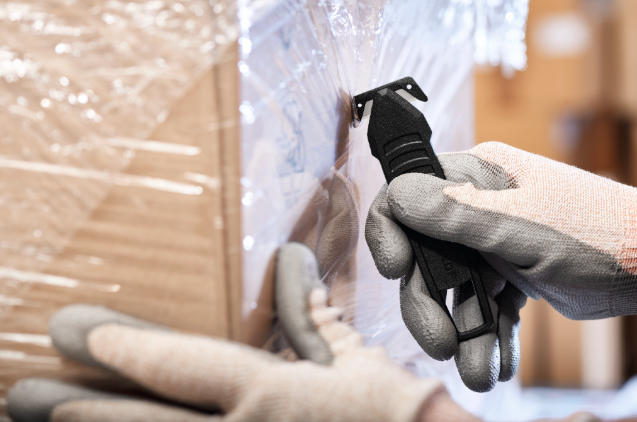
The SECUMAX 145 is MARTOR’s compact, entry-level safety knife for routine daily cutting tasks. At just 12 grams, it is extremely light — staff will barely notice it in hand, making it practical for continuous use throughout a shift.
Key specs: 12 g • 3.8 mm cutting depth • 0.5 mm blade • Disposable • GS-certified • Made from glass fibre reinforced recycled plastic (min. 60% recycled content)
Its concealed blade provides a 3.8 mm cutting depth — ideal for single-layer cardboard, film, packing tape, plastic strapping, and bagged goods — while keeping the blade safely shielded from fingers and merchandise at all times. The 2-in-1 blade head allows both cutting and piercing, and the ambidextrous design suits both left and right-handed users.
Best for: Front-of-house staff, fitting rooms, light goods receipt, and everyday unpacking of single-ply cartons and packing tape.
MARTOR SECUMAX 150 — The 3-in-1 Concealed Blade Workhorse
The SECUMAX 150 is a disposable safety knife with a fully concealed blade and a 3-in-1 blade head that handles the most common retail cutting tasks in a single tool: cutting, scraping, and splitting.
Key specs: 26 g • 6.2 mm cutting depth • Disposable • GS-certified • Made from glass fibre reinforced recycled plastic (min. 60% recycled content)
With a 6.2 mm cutting depth and two concealed cutting edges, the SECUMAX 150 handles 2-ply cardboard, film, plastic strapping, tape, and bagged goods with ease. The blade head’s guide surfaces help users cut at an angle, reducing material resistance — making it easier to work quickly and safely through high volumes of packaging. The outer blade area is non-sharp, so even the scraping and tape-splitting functions are safe to use.
Best for: Stock room and goods receipt staff handling a variety of packaging types — cardboard boxes, strapping, and tape — throughout the day.
MARTOR SECUMAX 350 — The High-Frequency All-Rounder
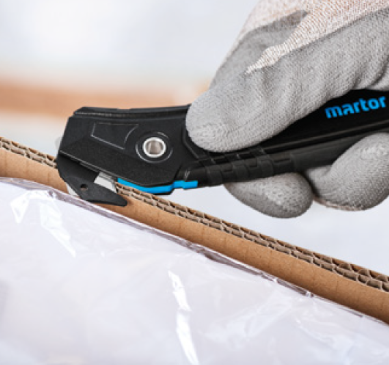
The SECUMAX 350 is MARTOR’s premium all-rounder for high-volume retail environments. Despite weighing just 38 grams, it is built for intensive, high-frequency cutting across a wide range of materials: film, plastic strapping, tape, 2-ply cardboard, textiles, and more.
Key specs: 38 g • 6 mm cutting depth • 0.3 mm blade • 2-in-1 blade head • Spare blade stored in handle • Tool-free blade change • GS-certified • Glass fibre reinforced plastic
Its 2-in-1 blade head features two cutting edges and two tape splitters. The blade can be flipped once to use the second cutting side before needing replacement, maximising blade life and reducing running costs. A spare blade is stored safely inside the handle, and blade changes are tool-free. The ergonomic design — with gently arched outer edges, soft grip, and light ribbing — fits comfortably in both left and right hands, making it a practical choice for diverse retail teams.
Best for: High-volume stock processing, busy goods receipt areas, and any environment where staff are opening large quantities of mixed packaging across extended shifts.
MARTOR SECUMAX 370 — The Heavy-Duty Goods Receipt Knife
The SECUMAX 370 is the world’s first GS-certified safety knife with a concealed blade and a maximum cutting depth of 10 mm. Where previous safety knives were limited to 6–7 mm — sufficient for standard cartons but not for thick corrugated stock — the SECUMAX 370 goes further, making it the right tool for goods receipt areas handling heavy 3-ply corrugated cardboard.
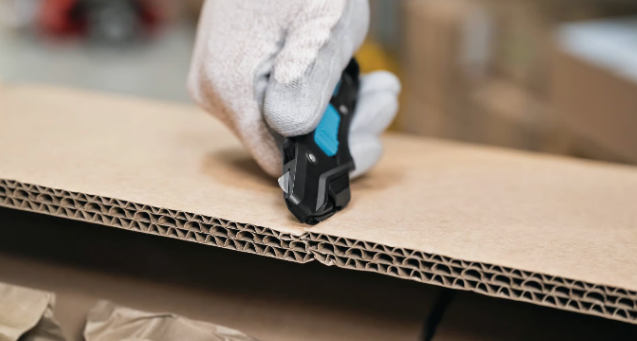
Key specs: 60 g • 10 mm max cutting depth • 0.63 mm reinforced blade • 2-in-1 blade head • Double-sided thumb slider for depth adjustment • Tool-free blade change • GS-certified • Ambidextrous • Made from glass fibre reinforced recycled plastic (min. 60% recycled content)
The cutting depth is adjusted via a double-sided thumb slider — the default position keeps the blade at its standard depth, and pressing the slider increases it up to 10 mm when needed for thicker material. The robust 2-in-1 blade head includes an integrated tape splitter, and the 0.63 mm reinforced blade handles the most demanding materials with ease. Tool-free blade changes and an ambidextrous design make it straightforward to use and maintain.
Best for: Goods receipt and warehouse staff regularly cutting thick 3-ply corrugated cardboard, heavy plastic strapping, and pallet wrap.
All four SECUMAX models share the same core safety principle: the blade is always fully concealed, protecting both the user and the merchandise inside the packaging. This is the fundamental design difference between a MARTOR SECUMAX safety knife and a standard box cutter.
View the Full MARTOR SECUMAX Range ›
Case Study: Australian Retailers Using MARTOR Safety Knives
Retailers using MARTOR Australia safety knives have consistently reported clear gains in daily operations. Businesses across grocery, apparel, and general merchandise have moved away from traditional box cutters in favour of SECUMAX cutting systems — motivated by a combination of WHS compliance requirements and the desire to reduce operational losses.
Common outcomes reported include fewer staff injuries, faster stock handling, less product damage during unpacking, and improved staff confidence when performing daily cutting tasks.
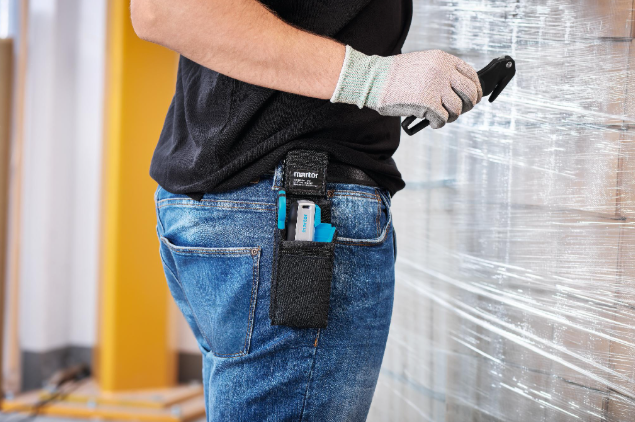
Key Features to Look for in Retail Safety Knives
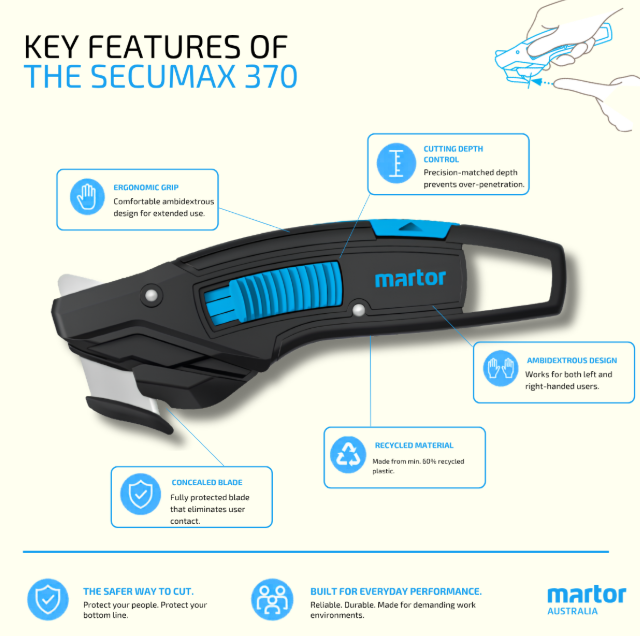
When selecting a safety knife for retail use, the following features make the most meaningful difference to both safety outcomes and operational efficiency. All are standard across the MARTOR SECUMAX range:
-
Concealed Blade: The blade is shielded at all times, protecting fingers during cutting and merchandise inside the packaging. This is the single most important safety feature and the defining characteristic of every SECUMAX model.
-
Fixed Cutting Depth Matched to Task: Each SECUMAX model is designed with a cutting depth suited to its intended application — 3.8 mm (SECUMAX 145) for light single-ply tasks, 6.2 mm (SECUMAX 150) for standard retail packaging, 6 mm (SECUMAX 350) for high-volume mixed materials, and up to 10 mm (SECUMAX 370) for thick 3-ply corrugated cardboard.
-
Ergonomic, Ambidextrous Design: All SECUMAX models are designed for comfortable, secure use during repetitive cutting shifts and suit both left and right-handed users.
-
Safe, Tool-Free Blade Replacement: The SECUMAX 350 and 370 feature tool-free blade changes with no direct blade handling required. The SECUMAX 145 and 150 are disposable, eliminating the blade change process entirely.
-
Durable, Sustainable Construction: Glass fibre reinforced handles made from at least 60% recycled plastic across the SECUMAX range — built for long-term retail use with a reduced environmental footprint.
-
GS Certification: All four SECUMAX models carry GS certification, providing independent verification that each knife meets rigorous safety standards.
Talk to a MARTOR Australia Workplace Safety Specialist ›
Conclusion
Unsafe cutting tools in retail stores affect day-to-day operations in ways that extend well beyond the visible injury. Australian retailers face compounding financial impacts — from workers’ compensation and medical costs, to damaged stock, elevated insurance premiums, and reduced operational output.
MARTOR SECUMAX retail safety knives address these risks directly by keeping blades fully concealed and providing cutting depths precisely matched to each task. Whether your team needs the lightweight SECUMAX 145 for everyday single-ply unpacking, the versatile SECUMAX 150 for mixed packaging, the high-frequency SECUMAX 350 for busy stock rooms, or the heavy-duty SECUMAX 370 for thick corrugated goods receipt — there is a purpose-built solution for every retail cutting environment.
The result is fewer incidents, less product damage, and a measurably safer workplace — all from a tool that typically costs less than $40 per unit. For any retailer still relying on standard box cutters, the question is not whether to make the switch — it is how much the delay is already costing.
FAQs
1. What are the most common injuries caused by unsafe cutting tools in retail?
Hand and finger lacerations are the most common injuries in retail cutting environments, typically occurring during carton opening and stock unpacking when blades slip or extend too far into packaging. Even minor lacerations often require medical treatment and can trigger workers’ compensation claims under WHS obligations. Replacing standard box cutters with a MARTOR concealed-blade safety knife eliminates blade exposure entirely, removing the primary cause of these injuries.
2. How much does a single cutting injury cost a retail store?
The total cost of a single cutting injury can exceed $15,000 when medical care, workers’ compensation, replacement staffing, lost productivity, and administrative time are all factored in. Safe Work Australia data shows the average compensation payment alone for a serious claim in 2020–21 was approximately $15,100 — and indirect costs add further to that figure. At $7–$40 per unit, a MARTOR safety knife pays for itself many times over by preventing even a single claim.
3. How do unsafe cutting tools cause product damage in retail?
Unsafe cutting tools with open or unguarded blades frequently damage merchandise when the blade extends too far into a carton. MARTOR’s SECUMAX range addresses this directly: every model uses a concealed blade with a controlled cutting depth, so the knife cuts through the packaging without reaching the goods inside.
4. What are retail safety knives, and how do they work?
Retail safety knives are purpose-built cutting tools designed to reduce both injury risk and product damage. Unlike standard box cutters with exposed blades, MARTOR SECUMAX knives keep the blade fully concealed within the knife body at all times — the blade only contacts the material being cut, never fingers or merchandise. Each model in the range offers a fixed cutting depth precisely matched to its intended application, from light daily unpacking through to heavy-duty corrugated goods receipt. See the product section above for a full breakdown.
5. How quickly can retail stores see a return on investment from safety knives?
Most retailers see a return within a few months of switching to MARTOR safety knives. Savings come from reduced workers’ compensation claims, lower product damage rates, and less staff downtime. At a typical cost of $7–$40 per unit, the investment is offset quickly — often by the prevention of a single injury or a reduction in weekly stock write-offs.
6. Are there real-world examples of retailers benefiting from safety knives?
Yes. Retailers across Australia and internationally that have adopted MARTOR safety knife programmes have reported significant reductions in cutting-related injuries and improvements in stock handling efficiency. MARTOR has documented substantial injury reductions among retail and logistics clients following the transition from standard box cutters to SECUMAX models.
7. What should retail managers consider when choosing safety knives?
The key consideration is matching the knife to the task — cutting depth, blade type, and whether a disposable or replaceable-blade model suits your operation. Look for a fully concealed blade, a comfortable ambidextrous grip, and GS certification as a minimum. The MARTOR SECUMAX range covers everything from light everyday unpacking to heavy-duty goods receipt; see the product section above for guidance on which model suits which environment. All MARTOR Australia products come with access to safety training support.